

A portion of Sharjah transforms into something difficult to explain without coming across as hyperbolic every January. Even with the more than 500,000 square feet of gallery walls, screening rooms, and tents, people manage to get lost in it. It’s not a grievance. At Xposure, taking the wrong turn usually leads to something worth stopping for, and this year—the tenth edition of the festival—that seemed to happen all the time.
It’s difficult to deal with the numbers alone. From more than 60 countries, more than 420 photographers, filmmakers, and visual artists came. The festival received a record 29,000 photography submissions and 634 film entries. Somewhere along the way, it was dubbed the largest photo festival in the world, a title that is frequently used in this industry but feels truly earned here. 95 exhibitions. over 3,200 pieces of art. It’s the kind of scale that begs the question of how someone could curate it without completely losing the thread.
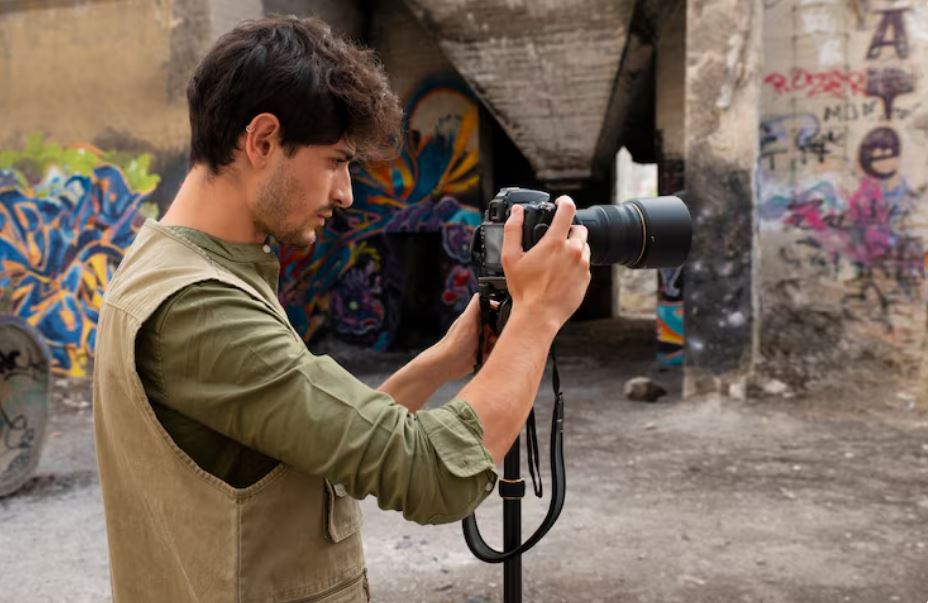
The way the festival arranges that mayhem is fascinating. Xposure is divided into thematic zones—documentary, photojournalism, nature and wildlife, conservation, fine art, portraiture, and travel—instead of a single, expansive exhibition space. It’s a subtle structural decision that allows the layered, dreamlike portraits of a fine art photographer and the frontline war photography of a Pulitzer Prize winner to coexist without feeling out of place. This closeness seems to be benefiting the field more than any panel discussion could.
This year’s event featured 66 films, a Conservation Summit on ocean ecosystems, and Athens as the festival’s first-ever Guest of Honour. Christoffer Relander, a Finnish-Swedish photographer who was exhibiting his solo show Alternature in the Fine Art and Creative Expression Zone, said that it was both intimidating and appropriate to be placed next to artists like Hengki Koentjoro and Søren Solkaer. According to him, fine art occupies a distinct but respected corner of a festival that is otherwise dominated by documentary and journalistic work. Although the conflict between photojournalism and fine art is not new, Xposure appears to manage it without imposing a hierarchy.
However, people kept returning to the conversations. The events that followed the exhibitions—coffee conversations that developed into partnerships, photographers from completely different fields exchanging notes—were more significant than the exhibitions themselves. Attendees frequently mentioned Bob Miller, who went on to win the festival’s Visual Storytelling award, as someone whose work changed how others perceived their own. Although it’s difficult to measure, that’s most likely the festival’s true purpose.
It’s still debatable whether Xposure is truly “reshaping” documentary photography or just giving it the biggest platform possible. A week of exhibitions doesn’t instantly alter the economics of photojournalism, and the festival doesn’t directly fund documentary work. However, putting so much talent, so many submissions, and so much public attention in one location for a week has an impact. It’s difficult to ignore how many photographers have already begun preparing their submissions for the following year. For better or worse, if this year is any indication, the next edition, which takes place in early 2027, will be even larger.
FAQs
What is Xposure 2026?
The world’s largest photo festival is held in Sharjah from January 29 to February 4, 2026.
How many photographers attended Xposure 2026?
More than 420 photographers, filmmakers, and visual artists from over 60 countries.
How many submissions did Xposure 2026 receive?
A record 29,000 photography entries and 634 film entries.
Who was Xposure 2026’s first-ever Guest of Honour?
Athens.
When is the next Xposure festival?
Early 2027.
