

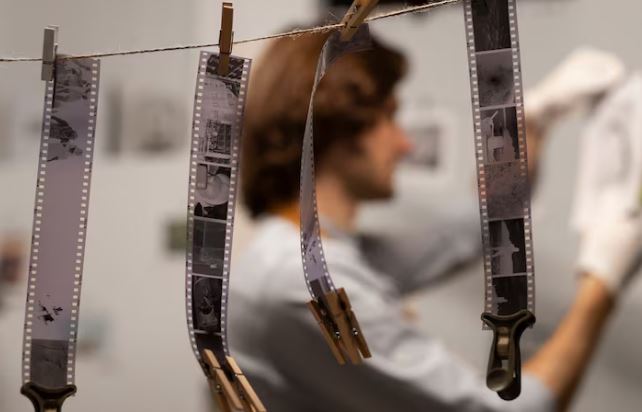
In 2014, Lev Bar-av left his film development machine outside in the rain after pushing it out of the rear of National Photo in Baltimore. “Done,” he thought. The customer base had dwindled to a single devoted Holocaust survivor and a few stragglers, the chemistry had become stale, and the entire process of processing analog film felt more like a slow obituary than a craft. Twelve years later, film now makes up about 70% of Bar-av’s business, and he has spent over $100,000 on new developing equipment. Something changed. It did, though it’s still a little difficult to pinpoint exactly when or why.
Although that wave is a component of the 2026 analog revival in documentary photography, it is not solely a Gen Z aesthetic experiment. More specifically, it is pushing working photographers—those whose careers depend on being trusted—back toward a medium that creates a tangible negative as evidence of their presence during the creation of an image. The film negative has gained a level of evidentiary weight that it never required before as AI tools produce more realistic images in a matter of seconds. Thus far, a prompt is unable to mimic a chemical reaction between light and silver halide crystals. That is more important now than it was even three years ago.
Beyond anti-algorithm posturing, there is a psychology at play here. The option of firing continuously and sorting through five hundred frames later is eliminated when shooting on a roll of 36 exposures, or 12 if working with medium format. In slightly different words, photographers who have gone back to film explain the same thing: you have to wait because the frame costs money. You wait for the light to be just right, for the subject’s expression to change, and for whatever is going on in front of the camera to become something worth taking a picture of. In a piece published earlier this year in Digital Camera World, Sebastian Oakley put it simply: doubling down on film in 2026 means picking a pace that permits errors and surprises. That appears to be a minor personal preference until you realize that the image’s authority as a document is precisely due to the surprise—the grain, the unexpected color shift, the slight exposure variation. In this case, authenticity is imperfection.
The manufacturers are barely able to keep up. Ektachrome was revived by Kodak. New stocks were created by CineStill for waiting lists. Ilford never stops making their black-and-white movies. Leica introduced Monopan 50, a brand-new black-and-white film made in partnership with ORWO in Germany that is intended for photographers who wish to have complete control over tonal range and work in bright environments or on tripods. A new film camera was unveiled by Ricoh’s Pentax division. After operating at a lower capacity for ten years, legacy manufacturing equipment is now operating more shifts. Instead of dying, the supply chain shrank and then began to strain in the opposite direction when demand reappeared more quickly than anyone had anticipated.
It’s difficult to ignore the stark contrast between this and the prevailing narrative a few years ago. In 2018, film was considered a hobbyist’s indulgence in photography forums; it was charming, perhaps sentimental, and most definitely not a career choice. In 2026, the discourse is significantly different. A cultural preference may have evolved into something more ethical as a result of the AI image issue, which may have sped up the process. The photograph that contains a tangible record of its own creation becomes a different kind of object when an image can be convincingly created from nothing. Not merely a picture. Proof.
It’s still unclear if the revival will continue to be a professional standard or if it will settle into a different market where documentary photographers use digital for daily filing and film for long-form work, coexisting without displacing one another. The labs are placing a wager on expansion. A second new machine was purchased by Bar-av. That’s a real wager, made with real money, by someone who once abandoned this entire enterprise. Reversals like that usually have a purpose.
