

Secretary Pete Hegseth’s staff prevented photojournalists from covering his updates on the Iran war twice this spring at the Pentagon, leaving only images approved by the government. Reports indicated that it was related to unfavorable photos from a previous session, but no one really explained why. Regardless of the true cause, the incident brought to light a more significant issue that has been developing for some time: a growing concern about who is in control of the image and whether it can be trusted after it is taken.
What this story covers:
- How C2PA-based Content Credentials are becoming a near-mandatory standard for verifying war photography in 2026
- The real-world tradeoffs photographers face in conflict zones, from battery drain to GPS security risks
- Why authenticated images matter for press credibility, even as emotional storytelling remains beyond what metadata can capture
Because of this fear, a feature that the majority of amateur photographers are unaware of is quietly and almost unnoticedly emerging as one of the most crucial features on a professional camera body. It is based on the C2PA standard and is known as Content Credentials. To put it simply, it’s a method by which a camera can cryptographically sign a picture as soon as it is taken, incorporating a digital fingerprint that records the camera’s make and model, the time, the location, and all subsequent edits. Imagine it as a notarized seal imprinted on the actual light.
When you put it that way, it sounds almost bureaucratic. It isn’t. This has become almost existential for photographers working in Gaza, Ukraine, or anywhere else where the distinction between a real and a fake image can influence public opinion or even military decisions. What it refers to as its Authenticity Imaging System has been introduced by Canon. Leica and Nikon have their own versions that are integrated at the sensor level instead of being added later as a software patch. The point is that the signing takes place before the photographer has a chance to consider it.
It’s important to consider why this is more important now than it was five years ago. The quality of AI-generated images has improved. Really, it’s uncomfortable. A still image taken from a generative model can depict children who were never hurt, soldiers who were never deployed, and smoke rising over an imaginary city block. Propaganda has always been drawn to conflict areas, but it used to take time and expertise to create convincing fake evidence. They need a reminder now. Photo editors at international syndicates are increasingly reluctant to run a file that cannot be traced back, and major newsrooms have taken notice.
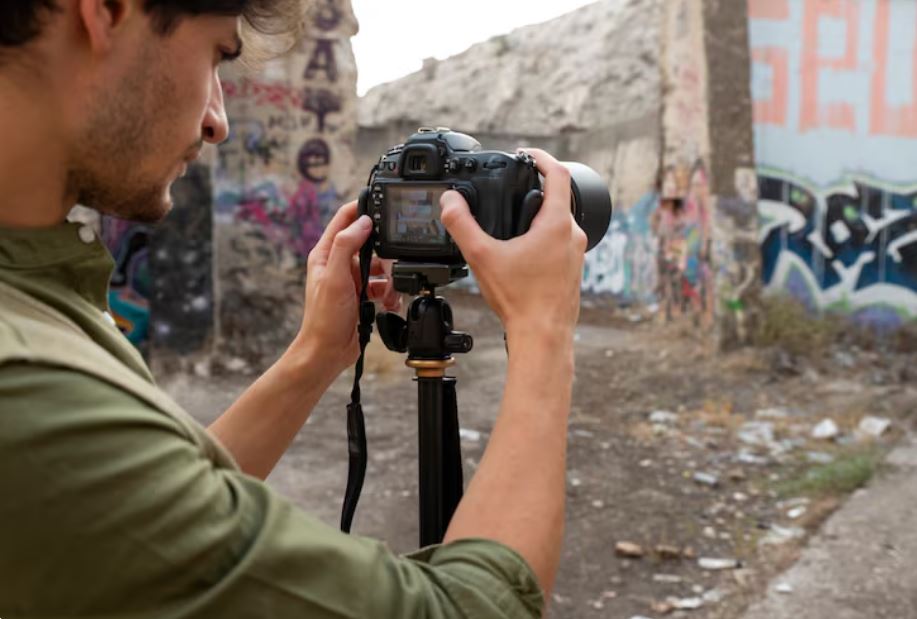
Photojournalists feel that this is no longer an option, unlike camera upgrades. It was nice to have a faster autofocus or a sharper lens. The digital counterpart of a press badge, verified provenance is evolving into something more akin to a credential. Major media outlets and wire services are beginning to handle unauthenticated photos the same way they would an anonymous tip with no supporting evidence: intriguing, perhaps, but not publishable. This is a significant change in the way editorial trust is developed, and it’s happening so quickly that some photographers feel like they’re rushing to catch up.
Even so, it’s difficult to ignore how disorganized the actual implementation is. Anyone who has actually shot in an active conflict zone will tell you that the trade-offs are real. When the closest outlet is a generator running on rationed fuel, continuous cryptographic signing and wireless authentication eat away at battery life at a rate that matters. Even worse, sending real-time GPS data while maintaining an uninterrupted provenance chain poses a serious security risk. The photographer’s location is not the only thing revealed if that signal is intercepted. Fighters or civilians who never consented to have their coordinates broadcast to anyone listening may be exposed by it.
That has a dark irony to it. In certain situations, a feature intended to preserve an image’s authenticity may endanger the individuals within it more than the image itself ever did. Photographers operating in regions such as eastern Ukraine have had to learn, frequently through trial and error, when to maintain the authentication chain and when to completely disable certain location features, accepting a slight compromise in verifiability in exchange for avoiding fatalities. The definitive playbook for that computation has not yet been written. Whether anyone has done so completely is still unknown.
It’s difficult to ignore the historical resonance here. The British photographer Sir Don McCullin, who documented wars from Vietnam to Beirut for decades, built his career on the notion that the camera bore witness—full stop—and that witnessing itself carried moral weight. In the past, there was no explicit agreement between the photographer and the viewer regarding the veracity of what you are seeing. It must now be incorporated into the hardware. Observing a whole industry construct a cryptographic framework around a level of trust that journalism once took for granted has an almost depressing quality.
However, machines are not the only aspect of the larger picture. This year, Dara Petrova has been subtly arguing that the most crucial facts in war aren’t always those that require forensic confirmation while taking pictures of Ukrainian civilians for PhotoVogue. No metadata standard can adequately convey the emotional authenticity of her photographs of techno raves under curfew, an elderly woman gradually forgetting her own past, and a soldier’s stepdaughter petting a cat after discovering her stepfather was missing. C2PA can demonstrate that a sensor captured light at a specific coordinate at a specific moment in time. It was never intended to demonstrate the significance of a photograph and is unable to do so.
It’s worthwhile to sit with this tension. At a time when confidence in photojournalism is desperately needed, some in the field seem to think that authentication technology will bring it back. Others believe it’s at best a partial solution, beneficial for institutional credibility but essentially meaningless to readers who have already made the decision to distrust a particular outlet for political or tribal reasons, regardless of the cryptographic signature hidden behind the pixels. Both are likely true at the same time, which is uncomfortable for an industry.
From the outside, it’s easy to classify this as technical housekeeping—the kind of specification improvement that only receives a paragraph in a camera review. That would be incorrect. The gradual introduction of provenance technology is changing who is trusted, which photos are published, and how much it now costs to demonstrate that a photograph wasn’t created by a machine in terms of battery life and combat risk. It will likely take a few more years to find a definitive answer to the question of whether that trade-off results in something feasible or merely adds friction to an already difficult job.
