

The idea of holding a photography festival inside one of Italy’s oldest libraries is subtly confrontational. Since the 18th century, the Biblioteca Nazionale Braidense in Milan has been cataloguing human knowledge. It has a distinct smell of old paper, rows of gilded spines, and an institutional gravity that tends to keep people silent. The contrast isn’t coincidental when you stroll through it during fashion week, with that specific outdoor noise of the city moving at its seasonal fever pitch. It seems to be the main idea.
In that same building, the 10th edition of the PhotoVogue Festival, Women by Women, opened on March 1. Amidst the artwork of 45 chosen artists chosen from almost 100,000 submissions, there’s a feeling that something has subtly changed about what this discussion is even about. When Alessia Glaviano and the Vogue Italia team organized the first festival ten years ago with the theme of the female gaze, the critical vocabulary was still mostly structured around opposition: women’s authorship was positioned as a corrective, and the female gaze was defined against the male gaze. It revealed structural imbalances. It was essential. In hindsight, it was also more of a beginning than a destination.
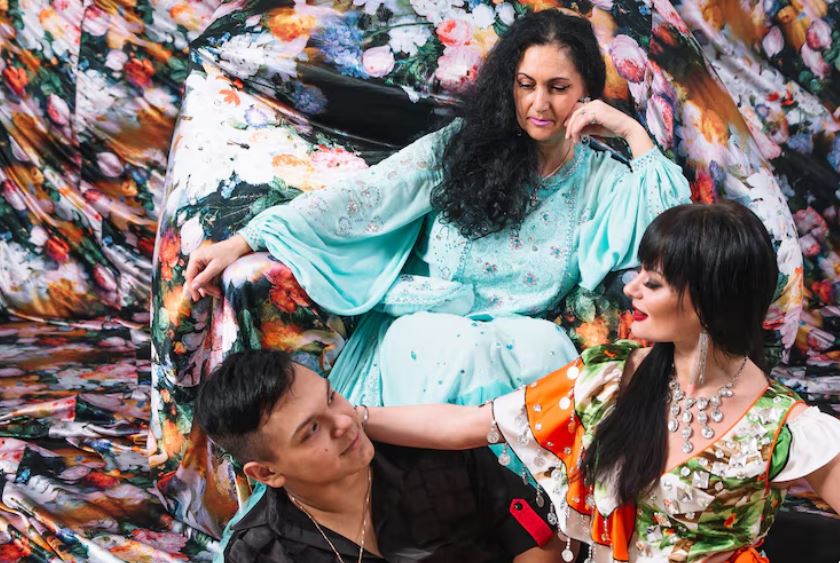
Through 150 photographers and filmmakers chosen from 149 nations, Women by Women suggests something more akin to an independent visual field. Hands are shown pressing skin into the shape of a smile in Carla Rossi’s series Bellissima; this gesture is both gentle and a little unsettling at the same time, which feels like the appropriate register. Black women are portrayed by Manyatsa Monyamane in compositions that purposefully mimic the formal weight of Old Masters paintings, entering and rearranging the canon rather than flattering it. Butterflies are applied to a woman’s skin by Kristina Podobed in a way that defies easy interpretation. These pictures don’t seem to be trying to explain themselves to anyone.
Another level of pressure is added by Futurespective’s partnership with Vogue Ukraine. Children are pictured among dried flower clusters in Ira Lupu’s Time of the Phoenix series, a family album that serves as a counter-archive to the prevalent imagery of war. Perhaps the emphasis on spectacle and rupture in war photography has always obscured as much as it revealed. Lupu’s work highlights that expense without overtly disputing it.
The lack of a particular aesthetic or regional sensibility is what stands out throughout the entire program. Forty photographers whose work defies interpretation as a cohesive whole are included in the East and South-East Asian Panorama. With the dedication of an archivist, Jake Verzosa records the last tattooed Kalinga women in the Philippines. Instead of using the private rooms of young Chinese women as decorative backdrops, Jiayue Li uses them as psychological territories. Nicole Ngai presents a close-up of a face with all of the skin’s texture, redness, and acne intact.
The library decision, according to Glaviano, was structural rather than confrontational. What constitutes cultural memory is determined by libraries. This body of work’s placement within that architecture is a claim rather than a transient intervention. Over the next ten years, it remains to be seen if the broader photography community will take that assertion seriously. However, the piece itself made a strong case for its own permanence when viewed slowly in that old building as fashion week moved outside.
FAQs
1. What is the theme of the 10th PhotoVogue Festival?
Women by Women — exploring how women see and represent themselves and each other.
2. Where did the 2026 PhotoVogue Festival take place?
Inside the Biblioteca Nazionale Braidense, a historic library in Milan, Italy.
3. How many artists applied to the festival’s open call?
9,500 applicants from 149 countries submitted work for consideration.
4. Who directs the PhotoVogue Festival?
Alessia Glaviano serves as Director of Global PhotoVogue.
5. Why was a library chosen as the festival venue?
Libraries legitimise cultural memory — placing women’s authorship there made a structural claim.
