

Carrots move along a conveyor belt inside a sorting facility in North Yorkshire at a speed that makes it difficult to follow individual shapes. They are observed by a device known as Focus, which measures angles, scans contours, and makes snap judgments. A carrot is ejected from the belt by a jet of air if it curves a few degrees more than it should. Every day, thousands of vegetables are rejected in this manner—not because they are unfit for consumption, but rather because they don’t look quite right.
When Tim Smyth first began giving this some serious thought, he was living above a pub in London. He was working in the kitchen below, keeping a close eye on food coming in and going out, noting what was used, what was thrown out, and what was ignored. Something clicked for him when he read about the optical scanning equipment used on big farms. He drove north to observe the business for himself after getting in touch with the proprietor of one of the largest carrot growers in North Yorkshire.
His discovery wasn’t particularly noteworthy. Bright lights, fast-moving belts, steel devices that resembled airport scanners, and an unending stream of orange were all typical of an agricultural scale. The ones that went through without any problems would end up on store shelves. The ones that didn’t—bent at angles the machine didn’t like, forked at the root, and scarred by fungal growth—were redirected. A portion went to animal feed. Some underwent processing to create other goods. It appears that some just vanished into supply chain calculations.
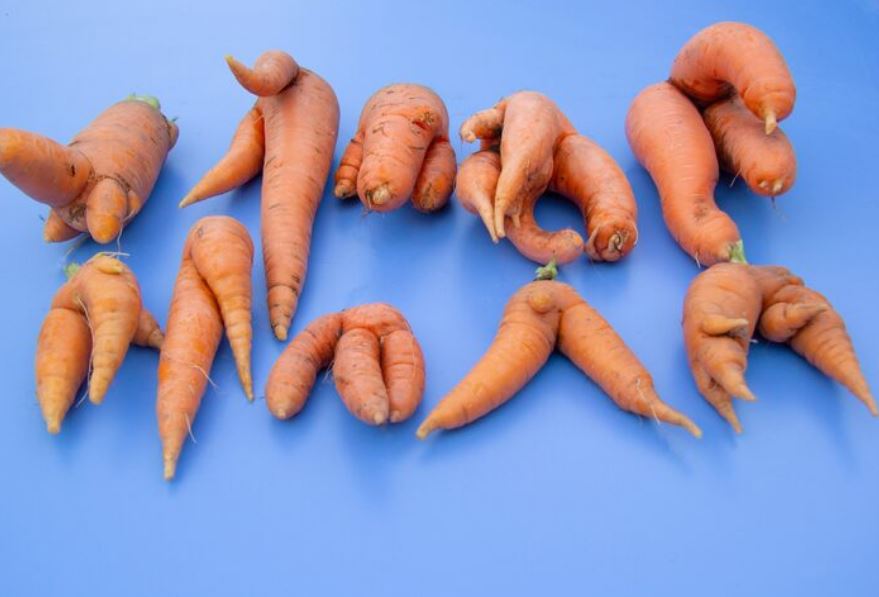
Smyth drove back to London after packing as many of the rejects as he could into his vehicle. He photographed them against stark white backgrounds in his studio for ten or twelve hours the next day. The procedure was meticulous and slow: light was adjusted, each vegetable’s silhouette was examined, and they were photographed as a natural history museum might record a discovery made during a dig. The final product was a limited edition of 500 copies of the photobook Defective Carrots, which included 56 photographs.
There’s an odd intimacy to the pictures. Carrots don’t appear to be vegetables that you would miss in a grocery store. They appear more like oddities from a cabinet of curiosities against plain backgrounds and under thoughtful lighting; they are twisted, forked, and occasionally suggestive in ways that led many viewers to use the word “erotic,” seemingly without much shame. There are some truly humorous photos. Some are more difficult to classify. Some appear almost depressing, which is an odd thing to say about a carrot.
The project likely attracted a serious audience in part because of that tonal range. The book was eventually added to the permanent collections of the Museum of Modern Art in New York and the Yale Center for British Art after being shortlisted for the PhotoEspé Photobook Award in 2014. Vegetables rejected by a machine for aesthetic reasons end up being preserved by some of the world’s most esteemed cultural institutions—a trajectory worth pondering for a moment.
It’s not difficult to read the commentary woven throughout that arc. Around the same time, the larger cultural discussion about “wonky vegetables” was starting to gain traction, and food waste activist Tristram Stuart wrote an essay for the book. Smyth, however, was not engaging in a polemic. He was taking pictures of carrots. If there is an argument, it comes from the pictures themselves, not from anything stated on the page.
Physically appealing, the book is bound in bright orange cloth with a foil carrot on the cover. It is clinical enough in its labeling of flaws (such as “fanging,” “scabbing,” and “crookedness,” all taken from Focus’s operating manual) to feel equally at home on a coffee table or in an archive. Some of the carrots were consumed by Smyth. He prepared soup. The remainder, in his words, fulfilled their destiny as stock feed on a city farm. But the pictures ended up somewhere else.
The fact that a project that was partially conceived in a pub kitchen, constructed from agricultural waste, and shot over the course of one exhausting day in a London studio ended up in New Haven and New York is subtly noteworthy. Museums don’t seem to be interested in whatever sorting machines optimize for.
