

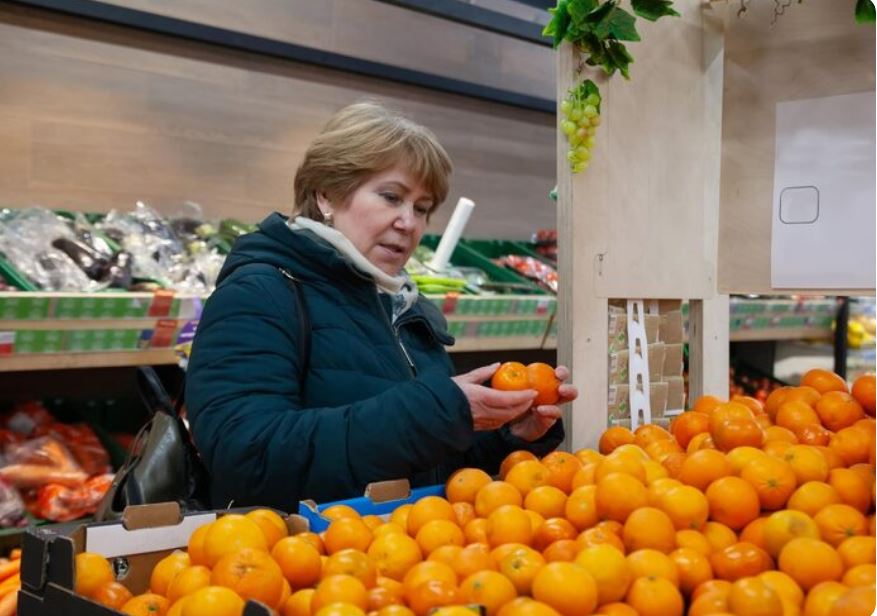
The food isn’t the first thing you notice when you walk through the produce section of any big supermarket—the lights are a bit too bright, the misters hiss on cue. The geometry is the problem. Bell peppers arranged in neat rows of matching red, apples stacked like pool balls, and cucumbers so homogenous they nearly seem artificial. That’s due to more than just taste. Architecture is what it is. An asymmetrical pepper is a problem in the produce aisle, which is a display designed to perform abundance.
In a sense, supermarkets are as much a part of the image industry as the food industry. Spec sheets that resemble design briefs rather than grocery lists are used by buyers for large chains. These sheets include diameter ranges for tomatoes, acceptable curvature for cucumbers, and scarring limits for apples that are as small as a quarter of an inch. Supermarkets choose produce to fit display cases evenly because, according to Imperfect Foods, one asymmetrical pepper has the power to defeat the entire pep squad. Until you’ve actually stood in a store and witnessed a stock clerk remove an uneven one from the pile, it sounds ridiculous.
This is supported by substantial numbers. According to research, up to 40–50% of the world’s fruit and vegetable production is lost annually, with cosmetic standards being one of the biggest preventable causes. In the European Economic Area alone, up to 51,500 kilotons of on-farm cosmetic grade-outs occur each year, generating about 22,500 kilotons of CO2-equivalent emissions, according to a study of European losses. The amount of waste related to cosmetics is estimated to be around 20 billion pounds annually in the United States. During quarterly earnings calls, no one boasts about these figures.
What makes supermarkets stick with the system, then? They do this in part. They’ve been trained to and in part because they’ve trained their clients. Consumer studies have repeatedly demonstrated that consumers create what psychologists refer to as “idealized prototypes” of produce—mental reference images formed by decades of grocery store displays and advertising that make an unevenly colored tomato appear suspicious even though it’s perfectly fine. A bent carrot doesn’t bother people who actually grow vegetables, according to studies. The rest of us don’t remember what a real carrot looks like.
The food-waste activist Tristram Stuart likes to share a helpful incident from 2007. Following severe flooding, British potato crops failed, and supermarkets, in need of inventory, quietly loosened their cosmetic regulations. All of a sudden, shelves were filled with potatoes that had eyes, wobbly shapes, and occasionally a lump of earth attached. Not a single retailer reported complaints from customers. It turned out that the industry found it difficult to acknowledge that the standards had been a form of self-imposed superstition. The regulations returned as soon as the shelves were replenished with glossier merchandise.
It’s particularly odd that the same industry that dislikes lumpy carrots will gladly make processed foods appear flawed. According to research from Georgia State University and other sources, Kraft spent two years creating an Oscar Meyer Carving Board turkey that appeared to be hand-sliced. Domino’s intentionally forms its Artisan Pizza dough into asymmetrical rectangles. For its Egg White Delight McMuffin, McDonald’s purposefully created an uneven egg patty. A small amount of asymmetry in processed food indicates human care. The same irregularity indicates neglect when it comes to fruit. It’s the kind of paradox that only makes sense when you realize that we are purchasing a narrative about the origin of the food rather than actual food.
It’s not just a cultural fear of asymmetry. It’s a commercial. Supermarkets operate on extremely thin profit margins, and they believe that a single apple that doesn’t look right at the front of a bin can cause a customer to reach for the display next door. This belief may be a combination of inherited folklore and truth. There are repercussions in either case. To protect themselves from rejection, farmers plant more. The Packers never stop sorting. The possibility that someone might pick up a pear with an odd shape and put it back down weighs heavily on the entire supply chain.
Patches of change have occurred. “Spuglies” were tested by Walmart in Texas stores. In Australia, Woolworths has an Odd Bunch line. European chains offer 25–50% price reductions on “inglorious” vegetables. By simply accepting what supermarkets won’t, startups like Misfits Market and Good and Fugly have created legitimate businesses. According to some researchers, these parallel channels may eventually cause demand to change, resulting in competition that drives down prices and helps farmers escape the grade-out trap.
The core machine hasn’t changed yet. It’s difficult to ignore the fact that the industry’s reluctance extends beyond logistics as you watch them skirt this issue. Certainty is sold in supermarkets. Customers are informed by a consistent display that standards are being met, quality control is genuine, and nothing is out of the ordinary. That silent promise is broken by an asymmetrical tomato. It implies that the world is messier than the aisle is willing to acknowledge, and that may be what the industry is most reluctant to expose under its fluorescent lights.
