

Julia Sonnleitner’s research contains a minor detail that lingers long after the page is closed. A child who fled Yugoslavia in the 1990s carried a wartime letter across borders, folding and refolding it for thirty years. In Austria, the child is now an adult. There is still the letter. It is not displayed, archived, or framed. It just exists, enduring in the same way that some things endure when practically nothing else does.
For a generation of artists working on migration, that kind of item—the kind that ought to have been lost but wasn’t—is starting to take center stage. The outdated vocabulary of statistics, arrivals, removals, and hallways has begun to seem insufficient. Numbers don’t hurt. An embroidered folk motif on a kid’s bag does.
The Visualisations of 20th-century Forced Migrations project, which brought together young artists from all over Europe and essentially asked them to make memory readable, is the best example of this change. The point is probably that the results are odd and inconsistent. Serbian Mladen Nikolić developed an obsession with two lighthouses in Panůvo whose bricks bore the names of the local ethnic Germans who had lived there before the war. Bricks with names. That’s all the proof. The houses, the pictures, the Tuesday morning routines—everything else is gone.
When writing about this type of work, it is tempting to use terms like “healing,” “restorative,” or other terms that minimize what is truly occurring. It’s not restorative. You get a sense of uncertainty as you read through Olga Filonchuk’s diary, page after page of embroidery and pictures from a German spa town where she landed with her sister and a seven-month-old niece after leaving Kyiv in March 2022. She’s not getting better. She is filming. There is a distinction, and that distinction is important.
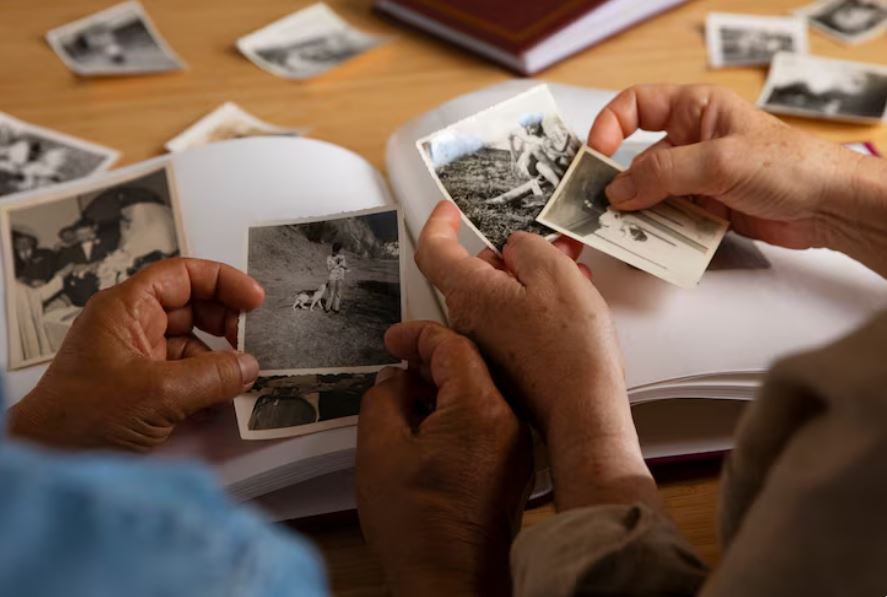
Igor Kopytoff and Janet Hoskins, who contended decades ago that objects have biographies similar to those of people, provide the theoretical framework for much of this work. Working at Sumba, Hoskins observed that her interview subjects were unable to share their life stories without holding something. A bag of betel. Something tiny, carved. Half of the conversation was spoken by the object. This concept is almost cruelly sharpened by forced migration. The few remaining items take on a burden they were never intended to bear when houses are looted, archives are bombed, and registry offices are set on fire. A spoon turns into a witness. A letter turns into a life record in court.
It’s difficult to ignore how frequently the bag is used as a motif. The bag is treated as the migrant’s oldest companion in Antonia Foldes’s hand-embroidered piece from the UK, which is stitched using overlapping folk traditions. You fill it with the past. You carry an uncertain future with you. The bag has knowledge that the bureaucracy does not.
Observing all of this gives the impression that art is being asked to perform tasks that history has not been able to. Memorials are constructed and then disregarded. Street names are altered and then forgotten. However, when combined with a Google Earth presentation that traces the same routes, a stained-glass window created by Liana Blikharska and Daria Koltsova about the deportation of the Crimean Tatars in 1944 refuses to fade into the background. It continues to insist.
It’s really unclear if any of this affects public opinion, policy, or the gradual erosion of cultural memory. Most likely, it doesn’t—at least not directly. However, it feels worse to imagine a world in which the wartime letter is eventually discarded by an attic cleaner. The artists in this area appear to be aware of how memory deteriorates on its own. You build evidence around it to slow down the deterioration.
