

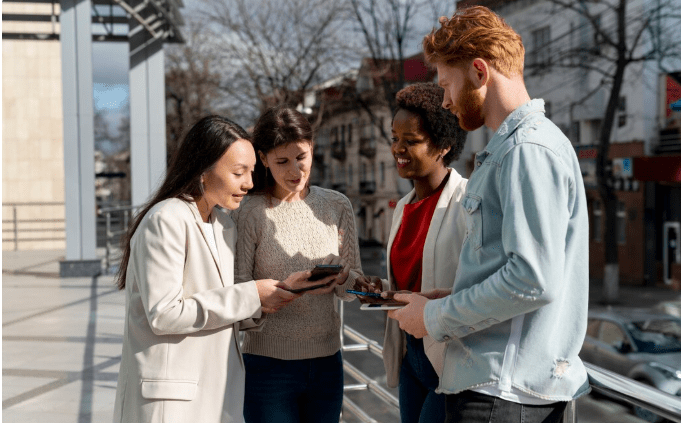
Today, whether in London, Seoul, or New York City, a pattern starts to show when you stroll through specific neighborhoods. murals that are thoughtfully placed on street corners. pastel-colored cafes with neon signs that are just bright enough for a camera sensor. staircases that appear to be more intended for framing a shot than for walking. People take pictures again, pause, and change the angles. The area has a well-curated sense of life.
It’s difficult to ignore how frequently the phone is used before anything else. For years, the concept of the “Instagrammable city” has been quietly developing, partly due to social media sites like Instagram, where pictures are shared more quickly than descriptions.
| Category | Details |
|---|---|
| Topic | Social Media Influence on Urban Design |
| Platform | |
| Field | Urban Planning, Architecture, Digital Culture |
| Key Concern | Designing spaces for visual appeal vs human use |
| Notable Insight | Up to 67% of architects report social media influencing design choices |
| Credible Organizations | The Guardian, ArchDaily, ScienceDirect |
| Reference Links | https://www.theguardian.com ; https://www.archdaily.com ; https://www.sciencedirect.com |
Many architects now acknowledge that social media has an impact on their creative choices, according to numerous design surveys. While it doesn’t necessarily dictate every project, this influence pushes aesthetics in the direction of what works well online—strong contrasts, clean lines, and visually arresting elements that translate into a square frame.
Public areas, such as markets, parks, and plazas where people congregated, lingered, and moved erratically, were historically created for interaction. Some of these same areas are currently being redesigned as visual experiences. According to analysts who write for ArchDaily, some projects are specifically designed to be “shareable,” meaning that users are expected to take pictures of them and share them. The architecture performs rather than just existing.
This makes sense economically. Cities vie for attention, and attention frequently results in visibility, investment, and tourism. In a matter of hours, a photogenic landmark can be seen on millions of screens, attracting tourists who wish to capture the same moment. Designing for the camera is therefore strategic rather than illogical. However, it also calls into question what is given priority.
Think about the selection of layouts and materials. On social media, bright colors, reflective surfaces, and symmetrical patterns typically work well. These decisions have the potential to create a sense of visual uniformity as well as vibrancy. As you stroll through various cities, you’ll notice that some parts start to resemble one another, as though they were filtered through the same aesthetic preferences. According to reports cited by ScienceDirect, platform algorithms frequently favor particular visual styles, subtly affecting how spaces are perceived and designed.
It has an impact on behavior in addition to architecture. In addition to experiencing a location, visitors record it. Reactions from the general public indicate that sharing has become an integral part of the experience. A viewpoint is captured, not merely appreciated. A café is curated rather than merely visited. A feedback loop is developing in which behavior is shaped by design and design is reinforced by behavior.
This loop may be changing the human experience of cities. Sometimes, photography-optimized spaces put a higher priority on appearance than comfort. There may be little seating, uneven shade, and pathways that take a backseat to the overall composition. Although they aren’t always evident, these trade-offs add up. They have the power to alter how people move through and engage with their surroundings over time.
However, not every impact is detrimental. Social media has increased the visibility of design and, to some extent, democratized it. Smaller communities and lesser-known cities can quickly become well-known, drawing investment and tourists that might have otherwise avoided them. Digital exposure can revitalize areas, bringing economic benefits and a renewed interest in local culture, according to reports from The Guardian.
In many well-known places, there is a recurring scene where a line forms for a picture rather than for entry. People wait for their turn in a designated area, frequently using online images as a guide. The experience is partially scripted and molded by preconceived notions. As this develops, it seems as though the city is being consumed as much as it is inhabited.
Even though they are invisible, algorithms play a major role in this change. Images that quickly grab attention—bold graphics, distinct focal points, and identifiable patterns—tend to be rewarded by platforms. Whether they realize it or not, designers react to these cues. This may eventually result in settings that are more in line with digital tastes than with basic human requirements.
The extent to which this trend will continue is still unknown. In opposition, some architects and urban planners prioritize community involvement, sustainability, and functionality over aesthetic spectacle. Others keep experimenting with designs that strike a balance between the two, producing aesthetically pleasing areas without compromising functionality. How these conflicting priorities develop could determine the result.
One thing that seems certain is that cities and images now have a different relationship. Urban areas are now more than just physical settings; they are also digital representations that are always changing and evolving. Opportunities and tension are brought about by this dual existence.
Standing in one of these thoughtfully planned areas gives the impression that the question is not whether beauty matters—it always has—but rather for whom. Either the audience observing from a distance or the people passing through it. And more often than not, the response could be both, negotiated in real time, one picture at a time.
