

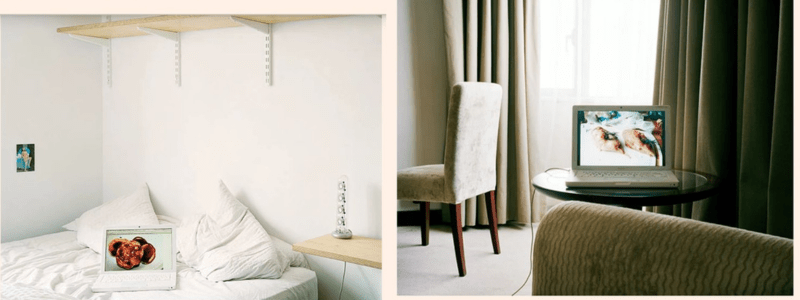
Hotel rooms have an understatedly eerie quality—the carpets with patterns. The lamps were the same. Even when muted, the television hummed softly as it was fastened to the wall. While on assignments that took him all over Britain and beyond, from Dublin to Los Angeles, Tim Smyth started to notice this sameness. Although each room is unique, they are uncannily similar. This may be where In Your Absence really started—not in a kitchen, but in those unidentified areas that seem detached from reality.
His partner was back in the kitchen in Nunhead, south London. On the counter, a loaf of bread is cooling. On a cutting board are raw chicken breasts. A casual arrangement of toast with tomatoes on a white plate. She would take pictures of these meals and forward them to him. Small digital products that span a region. Although Smyth characterizes them as a shared indulgence, there is a sense that something more complex was going on when viewing the resulting photos.
In Your Absence — Project Overview
| Field | Information |
|---|---|
| Title | In Your Absence |
| Artist | Tim Smyth |
| Year Initiated | 2011 |
| Project Type | Ongoing photographic series |
| Genre | Still Life, Documentary Photography |
| Primary Medium | Digital photography (re-photographed digital images displayed on phone/laptop screens) |
| Concept | Reinterpreting meal photographs sent via email by the artist’s partner while he was traveling abroad |
| Origin Location | Developed during a six-week stay in Italy; meals photographed in Nunhead, South London |
| Core Themes | Distance, digital intimacy, domestic life, technological mediation, emotional absence |
| Visual Structure | A digital image of food displayed on a device, placed within impersonal hotel or temporary interiors |
| Emotional Focus | Longing, connection through screens, modern isolation, collaborative intimacy |
| Cultural Context | Early exploration of hyper-connected communication culture before widespread remote living trends |
| Collaboration Element | Indirect artistic collaboration between Smyth and his partner |
| Exhibition History | Exhibited during Smyth’s residency around Festival Dei Due Mondi, Spoleto |
| Related Works | Defective Carrots, My Son’s Absence |
| Reference Website | https://www.ft.com/content/f8da2c6a-7c8f-11e7-ab01-a13271d1ee9c |
During a six-week stay in Italy in 2011, Smyth began using these emailed photos to create his own still-life paintings. The focus of the images in In Your Absence is her digital photos sitting in otherwise sterile settings on the screen of his laptop or phone. The screen’s glowing rectangle takes center stage, representing the warmth of the home through cold technology. The tension there is difficult to ignore.
In actuality, the project is straightforward. While away from home, a photographer reinterprets his partner’s meal photos. However, the simplicity seems misleading when one is in front of one of the pieces. A hotel desk that is dark is illuminated by the laptop screen. The bread appears appetizing, but it has been compressed into pixels. The closeness is there, but it’s out of reach. It’s as though you’re tasting something that doesn’t exist.
Smyth has expressed dissatisfaction with our reliance on portable electronics. The compositions, which carefully frame screens that emphasize distance while promising connection, reflect this frustration. In Your Absence subtly raises the question of whether constant closeness is sufficient in a time when FaceTime calls and Instagram stories give the appearance of it. Whether digital intimacy strengthens relationships or just makes being away more bearable is still up for debate.
The collaboration at the heart of the series is what really sticks out as you watch it develop over time. It was his partner who organized these meals, not Smyth. She prepared food. She took pictures. He answered. Something like an artistic duet performed via Wi-Fi signals, there’s something almost tender about that exchange. This might be the reason the piece stays away from sentimentality. Distance is not dramatized. It records it.
The series seems even more prophetic in light of the larger cultural backdrop. Smyth was investigating the mechanics of mediated presence long before pandemic lockdowns made remote meetings, dinners, and friendships commonplace. In some respects, In Your Absence foresaw a society where relationships are preserved via glowing screens. However, it doesn’t commemorate that change. If anything, it appears doubtful.
The actual settings in the pictures are important. desks in hotels. neutral bedding. artificial illumination. The kind of places that are meant to be forgotten. The pictures of home-cooked meals seem almost rebellious against that background. In Nunhead, a loaf of bread has texture, weight, and smell. It turns into a flattened echo on an Italian laptop screen. As this develops, it seems that the show is more about what technology eliminates than it is about food.
Smyth’s interest in value and visibility is evident in his larger body of work, especially Defective Carrots. He captured vegetables that were rejected by supermarket standards in that series, bringing beauty to the underappreciated. He applies that same lens to emotional experience in In Your Absence, exploring the effects of filtering intimacy through circuitry and glass. Both projects challenge the notion of what is “complete,” though in different ways.
One could easily interpret In Your Absence as a critique of contemporary society. However, that seems too direct. The images don’t explicitly criticize technology. They depend on it. The cooperation would not be possible without smartphones and email. Rather, the show lingers in that awkward middle ground, acknowledging the ease of digital connectivity while alluding to its shortcomings.
Smyth appears to understand the distinction between confession and documentation. The work is restrained but personal. Analytical but emotional. The series’ longevity may be attributed to that balance. We can identify with it as viewers. The scrolling late at night. The message from a distant source. the feeling of loneliness and connection.
It’s unclear if In Your Absence will become nostalgic or stay incredibly relevant. Faster connections and sharper screens are two examples of how technology is constantly evolving. However, the basic conflict between presence and absence doesn’t change. The silent void between seeing and being there is what Smyth most effectively depicts.
