

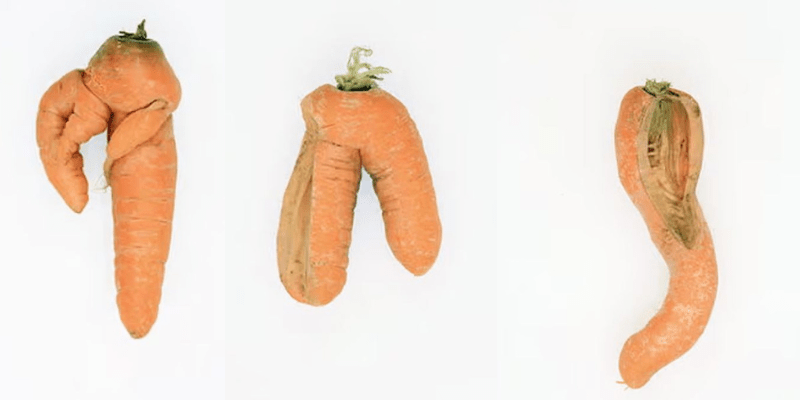
It is easy to see how cruel contemporary food standards can be when one is inside a North Yorkshire vegetable sorting facility. Carrots pass through a device that looks like an airport scanner as they move along a conveyor belt under bright industrial lights. The Focus device analyzes each carrot’s shape with mechanical precision in a matter of seconds. The vegetable is ejected from the belt by a sudden burst of air if it curves too sharply or splits slightly close to the root. Perfect carrots keep going. The flawed ones disappear.
Photographer Tim Smyth may have found his subject in this moment—the instant a carrot is turned away because it is a little crooked.
British photographer Smyth, who was born in Bristol in 1985, had already been considering food waste. He had spent time rescuing vegetables from supermarket trash cans and restaurant bins, arranging them into still lifes on nighttime city streets, before starting Defective Carrots. Photographed in low streetlights, those quiet experiments suggested a greater curiosity. Why were so many edible items discarded?
Defective Carrots — Project Overview
| Field | Information |
|---|---|
| Title | Defective Carrots |
| Artist | Tim Smyth |
| Year of Project | 2011 (photography series) |
| Book Publication | 2013 |
| Publisher | Bemojake |
| Format | Artist photobook |
| Photographs Included | 56 color images |
| Medium | C-type photographic prints |
| Subject | Misshapen or rejected carrots removed from supermarket supply chains |
| Location of Source | North Yorkshire carrot farm, England |
| Themes | Food waste, consumer standards, agriculture technology, visual perception |
| Book Edition | Limited edition of 500 copies |
| Collections Holding the Work | MoMA, Yale Center for British Art, Joan Flasch Collection |
| Award Recognition | Shortlisted for PhotoEspaña Photobook Award 2014 |
| Reference Website | https://modernfarmer.com |
It turns out that appearance frequently determines the answer. Smyth learned that thousands of carrots were rejected every day at the North Yorkshire farm just because they didn’t look good enough. Some were truly unique, scarred by fungal marks, knotted into odd shapes, or split like tuning forks. Others appeared nearly normal, with one side being slightly thicker or slightly crooked. It’s difficult to avoid feeling a hint of absurdity as you watch them fall off the conveyor belt.
Before heading to London, Smyth gathered as many as he could fit in the back of his car. He photographed them in his studio for almost twelve hours the following day. The process of lining up carrot after carrot, examining their peculiar silhouettes, and modifying the lighting until each one looks oddly sculpture-like has an almost compulsive quality.
The resulting images from this extensive process have an unexpectedly personal feel. The carrots appear more like odd biological specimens than vegetables against stark white backgrounds. A few look like twisted fingers. Others have curves reminiscent of abstract sculpture. Some of them lean toward shapes that viewers might politely refer to as “suggestive,” which makes them inadvertently humorous.
This subliminal humor might contribute to the project’s allure. However, beneath the surface lies the deeper message.
Visual homogeneity is crucial to modern agriculture. Produce that stacks neatly, takes good pictures, and reassures customers with recognizable shapes is preferred by supermarkets. Farming practices are subtly influenced by this expectation. To guarantee that enough ideal vegetables survive sorting machines, growers plant larger quantities. Ten to twenty percent of the harvest is sometimes diverted to other uses.
Some are fed to animals. They chop some into processed foods. Some just vanish.
One gets the impression from looking at Smyth’s photos that the rejected carrots are subtly protesting their lot in life. You can still eat them. Many are just a little bit off. However, because they failed a machine-designed and consumer-reinforced cosmetic test, they were removed from the system.
In her essay for the book, food waste activist Tristram Stuart pointed out how little variety supermarkets really permit. The variety of shapes can be surprisingly small, even among carrots that are rejected. After finishing the book, that observation begs the question, “How narrow have our expectations become if even imperfect vegetables are still fairly ordinary?”
There is a certain tactile charm to the book itself. It feels almost playful, bound in bright orange cloth with a foil carrot stamped on the cover. 56 photos and brief diagrams that describe flaws like “fanging,” “scabbing,” and “crookedness”—all taken straight from the sorting machine’s manual—are included. It’s a unique blend of an agricultural document and an art book.
Defective Carrots has been quietly making its way through the art world since its 2013 release. Copies ended up in important collections, such as the Yale Center for British Art and the Museum of Modern Art in New York. It’s a little ironic that trajectory. Eventually, vegetables that a sorting machine rejected found their way into museum archives.
As this develops, it seems as though Smyth’s project touched on a realm beyond photography. Over the past ten years, there have been more discussions about food waste. Legislation has been discussed by governments. In North America and Europe, there have been campaigns urging people to purchase “ugly produce.”
It’s difficult to say whether Defective Carrots had a direct impact on those conversations. However, the pictures stick in your mind. They alter people’s perceptions of vegetables in a grocery store bin once they are seen.
There’s a chance that someone will wonder about the crooked carrots that were left behind the next time they pick up a perfectly straight one.
