

The sizzler, which smells of char, butter, and something appropriately decadent, arrives at the table trailing smoke. In a dimly lit South London restaurant, two people are seated across from one another. Based on their careful attire and somewhat formal stance, it is obvious that they are on a date. One reaches for a phone before the other picks up a fork. The other is waiting. The food cools. Contentment takes over the moment.
This scene is not uncommon. In actuality, it is now so commonplace that it hardly qualifies as unusual. Dinner’s true purpose changed when, at some point in the past ten years, the custom of sharing a meal subtly welcomed a new participant: the camera. Anthropologists have documented communal eating in almost every human culture throughout history, demonstrating the social significance of food. The idea that the meal must be observed by those who are not present is more recent and much more intricate.
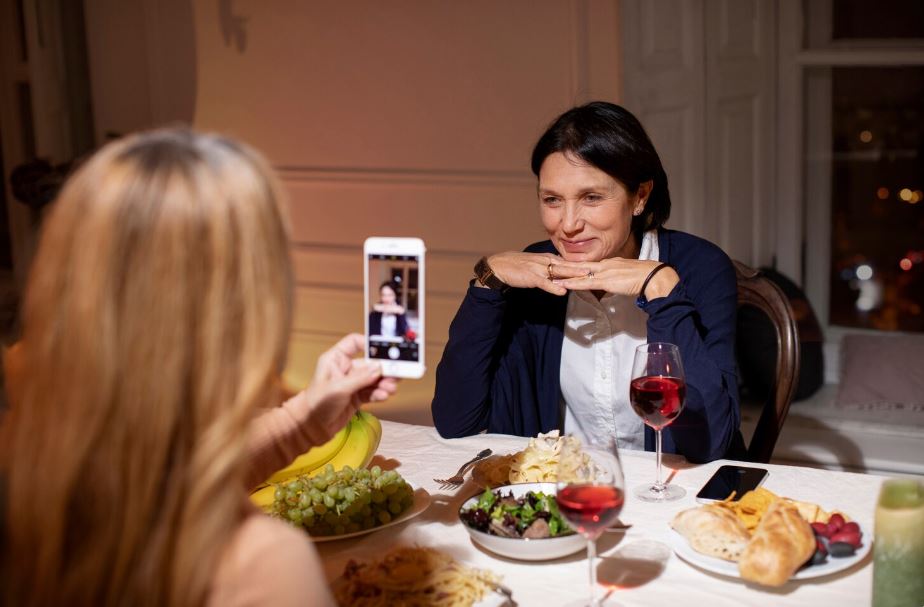
The expression “camera eats first” was first used in Hong Kong to describe the custom that is now followed all over the world: photographers feed their camera before they feed themselves. Put simply, it sounds ridiculous. However, there are over 180 million photos on Instagram alone with the simple hashtag #food, and an estimated 90 new uploads with the hashtag #foodporn appear every minute. 54% of people aged 18 to 24 have taken pictures of food while dining out, according to a News Limited survey.
| Field | Information |
|---|---|
| Topic | Food Photography, Digital Dining Culture & Relationship Intimacy |
| Cultural Phenomenon | “Camera Eats First” — the ritual of photographing food before eating it |
| Platforms Driving the Trend | Instagram, TikTok, Facebook, Pinterest, WhatsApp |
| Scale of the Behaviour | Over 180 million photos tagged #food on Instagram; an estimated 90 new #foodporn uploads every minute |
| Age Group Most Active | 54% of 18–24 year olds have photographed food while dining out (News Limited survey) |
| Psychological Concept | Visual hunger and digital satiation — viewing food images creates psychological satisfaction before eating |
| Positive Dimension | Digital commensality — sharing food photos across distances to maintain intimacy with absent loved ones |
| Key Tension | Sensory and emotional presence at the table vs. performance for an online audience |
| Relationship Impact | Reduced conversation, disrupted atmosphere, food experienced cold — replacing taste with social validation |
| Further Reading | The Sociological Review on consuming food digitally |
Nearly 40% have made it public. These behaviors are not considered fringe. They are popular ones that subtly change the meaning of sitting across from someone. The effects on intimacy are easier to see but more difficult to measure. Researchers and therapists who work with couples have observed a pattern that is becoming more and more common: one or both partners showing up to dinner focused on documenting the evening rather than each other. The food is set up.
The lighting is evaluated. The same shot is taken multiple times. In the meantime, the companion waits to start while sitting in a state of suspended animation. Before a single bite is taken, the social contract of the shared meal—that the table is a place set apart from everything else, a container for undivided attention—is broken. What comes next may feel more like a photo shoot with a meal than a dinner.
This is an important psychological mechanism to comprehend. The idea of “visual hunger”—the brain’s reaction to appealing food imagery—was first presented in a study that was published in ScienceDirect. The study also found that eating pictures of food can produce a type of digital satiation, a feeling of partial satisfaction that actually precedes and can dull the direct sensory experience of eating. Food that is partially consumed before it reaches the mouth is food that is experienced through a phone screen.
By then, the temperature is already off. The texture has started to shift. Instead of enjoyment per se, what’s left is a performance of enjoyment. This may be structural rather than incidental, that the diner’s hierarchy of senses is fundamentally rearranged when a meal is photographed for an audience. Sight is supreme. The qualities that make food appealing, like texture, temperature, and smell, diminish.
For years, restaurants have been observing this and reacting in more direct ways. The disruption that phone cameras cause in dining rooms has been discussed in public by chefs in Manhattan and Paris. One New York chef was quoted in the Times as saying that it is “hard to build a memorable evening when flashes are flying every six minutes.” As a sign of an emerging counter-movement—a growing appetite, so to speak, for the unmediated meal—some establishments have started actively discouraging photography. The irony is that the restaurants that are most frequently photographed are also the ones that are most likely to adopt such policies.
However, it would be too simple to characterize all of this as merely destructive. The connection between food and digital sharing is actually more nuanced than that, and people’s inclination to take pictures of what they eat has merit.
Food has always served as a medium for memory, identity, and communication. The 19th-century proverb “tell me what you eat, and I will tell you what you are” by Jean Anthelme Brillat-Savarin foreshadowed Instagram by roughly 200 years. In terms of emotional logic, sharing a picture of a home-cooked meal on WhatsApp with a sibling who lives abroad is similar to the Thanksgiving table spreading across digital platforms, where Instagram reported 10 million food-tagged uploads in a single day. The table is extended. In some tiny way, those who are unable to be present nevertheless become present.
Observing all of this, I get the impression that the discussion surrounding food photography is actually a stand-in for a much older dispute about attention: where it goes, who gets it, and what we owe one another when we sit down. The phone at the table is merely the most recent edition of the newspaper for breakfast, the television for dinner, and the diversion that causes you to prioritize something else over the person in front of you.
Scale and frequency, as well as maybe the fact that something else is active rather than passive, are what give it a different feel. Unlike reading a newspaper, taking pictures of a meal does not mean ignoring your companion. It involves doing something, such as creating, curating, or publishing, and that activity has its own gravity and demands, drawing attention away purposefully rather than aimlessly.
After all of that, there’s still a meal to be had—the cold sizzler, the waiting companion, and eventually the phone back in the pocket. The question of whether it is the one that was intended to occur is quite different.
