

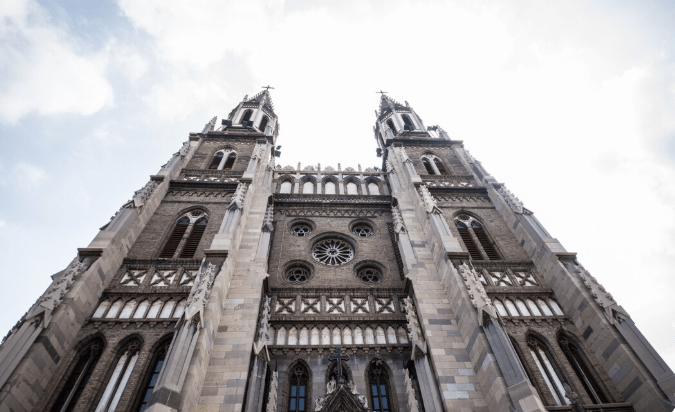
Scaffolding encircling an incomplete structure has a strangely familiar appearance. For centuries, Málaga Cathedral in southern Spain has stood partially unfinished, with its missing tower practically becoming a part of its identity. According to reports from ArchDaily, contemporary architects are using timber technology to complete the work started by Renaissance builders. It’s a continuation of history, but it also poses a more subdued question: who gets to complete a cathedral and determine its future?
It is evident when strolling through older European cities that cathedrals were more than just structures. Masons, carpenters, and artists who seldom signed their names shaped these slow, generational collaborations. In this way, today’s unlicensed artists—those who erect temporary structures in neglected urban corners or paint murals on abandoned walls—don’t feel wholly novel. Rather than working outside the tradition itself, it seems like they are merely operating outside the permission structures that formerly controlled the construction of cathedrals.
| Category | Details |
|---|---|
| Topic | The New Cathedral Builders: Artists Redefining Architecture Without Permission |
| Key Reference Sites | ArchDaily, BBC, MDPI |
| Notable Example | Málaga Cathedral |
| Historical Case Study | Beauvais Cathedral |
| Themes | Architecture, Art, Urban Intervention, Heritage |
| Sources | ArchDaily (2024), BBC Culture, MDPI Heritage Journal (2025) |
When one considers Beauvais Cathedral, the comparison becomes more pronounced. The cathedral’s ambition pushed engineering boundaries to the point where some of it collapsed, according to research released by MDPI. It was an ambitious project that was motivated by both calculation and vision. Today’s artists frequently use a similar combination of daring and uncertainty when putting together large-scale installations without official approval. Their “cathedrals” may last for days rather than centuries, which is the difference.
The public’s response to these interventions is rarely consistent. Some people may perceive a mural that appears overnight in a crowded neighborhood as vandalism, while others may see it as a sign of rebirth. A similar question was once raised by the BBC: can contemporary architecture itself occasionally resemble vandalism when it collides with the past? It appears that the tension has changed. These days, independent creators are also being evaluated similarly to architects, with their work straddling the line between disruption and contribution.
There is a discernible pattern in many cities, especially those that are experiencing rapid development. Underpasses, construction fences, and vacant lots serve as makeshift canvases. Artists frequently work at night and move quickly, leaving behind structures or visual statements that alter the perception of a space. It’s difficult to ignore how these instances change a location’s rhythm. Suddenly, attention is drawn to a boring concrete wall. A neglected alley turns into a destination. These are minor adjustments, but they add up.
It’s intriguing how much this resembles the spirit of cooperation that is discussed in essays that use “cathedral building” as a metaphor for society. The notion that architects, builders, and artists must collaborate seems more and more important, particularly since formal systems occasionally marginalize artistic perspectives.
Innovation frequently stalls when creativity is divorced from practical execution, according to reports and commentary. Unauthorized artistic interventions in that setting might be more about filling a void than they are about rebellion.
However, there is still an unresolved underlying tension. Today’s “cathedral builders” work without long-term guarantees, in contrast to medieval cathedrals, which were supported by institutions and resources. It is possible to erase their work overnight. A mural covered in paint. A building was taken apart. This transience may contribute to its allure, but it also calls into question sustainability and acknowledgment.
At the same time, cities are becoming more receptive to these initiatives. After initially removing their artwork, some local governments now commission street artists. Others designate areas for experimentation in an effort to strike a balance between creativity and control. As this change takes place, it seems as though institutions are gradually, if grudgingly, adjusting to a style of architecture that doesn’t wait for approval.
The materials themselves convey a different narrative. Modern interventions frequently use reclaimed wood, metal scraps, or temporary installations, whereas historical cathedrals relied on stone and glass. This move toward flexibility is reflected in the timber innovations being introduced in Málaga, which are lighter, more versatile, and made to coexist with heritage. It implies that the improvisational techniques of artists operating outside the system are starting to influence formal architecture as well.
Still, there’s a problem. Cathedrals were constructed to last for centuries, defining skylines. The impact of today’s unapproved works is often measured in attention rather than permanence, and they are frequently transient. It’s unclear if that signifies a loss or just a different kind of legacy. Reactions from the public indicate both admiration and discomfort, sometimes in equal measure.
How these projects are remembered is perhaps the most illuminating detail. Even when they are unfinished, historical cathedrals bear the burden of collective effort. Even though they are less long-lasting, contemporary interventions appear to capture a similar impulse: the desire to create something meaningful, leave a mark, and shape space—even without permission. Even though the scale has changed, it’s difficult to ignore the connection there.
What appears is a parallel practice rather than a substitute for traditional architecture. One that functions more quickly, more erratically, and frequently more closely in ordinary settings. It is still unclear if these artists will eventually become part of formal systems or stay on the periphery. For the time being, however, they are quietly and steadfastly constructing cathedrals of a different type.
